
Why Your Child Still Struggles With Long O Words (And What Actually Builds Fluency)
Many students can decode simple CVC and CVCC words but struggle when long O spelling patterns appear in more complex words like hope, boat, snow, though, and remote. Long O phonics requires flexible decoding, strong orthographic mapping, and consistent sound-to-spelling practice. In this article, you’ll learn why long O words cause difficulty and how structured phonics instruction builds reading fluency and accurate spelling.
Many students can read CVC words (consonant-vowel-consonant) such as hop, not, and cot accurately. Some can even manage CCVC or CVCC words like stop or hand.
But when they encounter long O words such as:
hope (CVCe)
boat (CVVC)
snow (CCVC with vowel team)
toe (CVC with vowel team)
though (complex vowel pattern)
fluency begins to break down.
This is not a comprehension issue. It is an advanced phonics pattern issue.
Long O phonics introduces multiple spelling patterns that students must recognize automatically.
Long O Is an Advanced Code Pattern
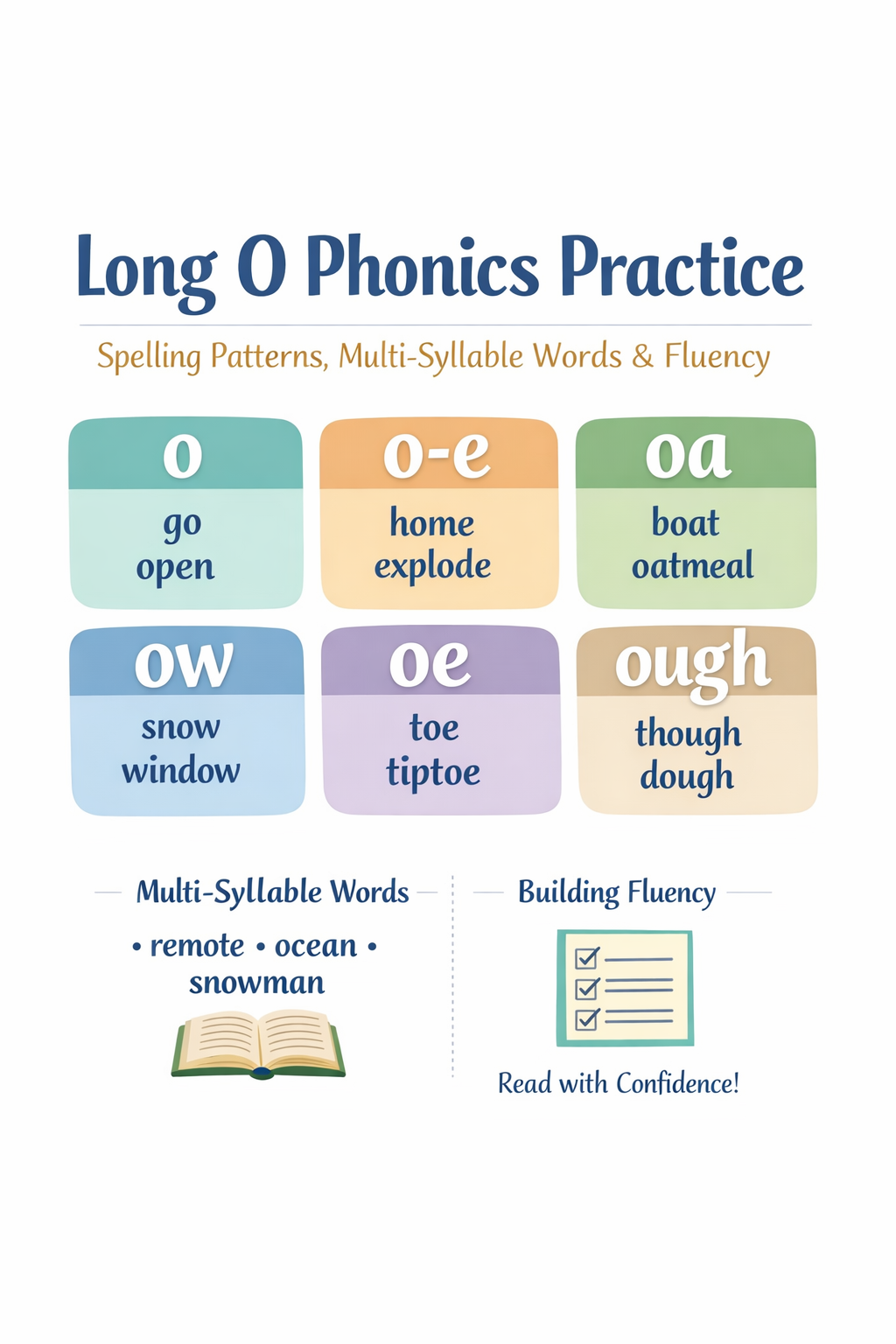
Common long O spelling patterns include:
o (open, moment)
o-e (hope, explode)
oa (boat, oatmeal)
ow (snow, window)
oe (toe, tiptoe)
ough (though, dough)
Students who are comfortable with CVC decoding often struggle when:
• A silent e changes the vowel sound
• A vowel team appears in the middle of a word
• The long O appears in a multi-syllable word
For example:
remote (re-mote)
program (pro-gram)
ocean (o-cean)
moment (mo-ment)
snowman (snow-man)
explode (ex-plode)
These words require both syllable awareness and strong long O pattern recognition.
The Role of Orthographic Mapping in Long O Words
Orthographic mapping is the process that permanently stores words in memory by connecting sounds to spelling patterns.
For example, in hope:
/h/ /ō/ /p/
Students must recognize that the long O sound is represented by o-e.
In though, students must understand that ough represents the long O sound.
When students:
Say the word,
Segment the sounds,
Map each sound to letters,
Write the word while saying sounds,
they strengthen orthographic mapping and long O spelling accuracy.
Without this process, students often spell:
hope as hop
boat as bot
though as tho
Structured long O phonics instruction directly supports spelling development.
What Effective Long O Worksheets Should Include
Strong long O worksheets and long O phonics activities should include:
1. Sorting by Spelling Pattern
Students sort long O words by o, o-e, oa, ow, oe, and ough.
2. Sound-to-Print Mapping
Students stretch sounds and write long O words while saying each sound aloud.
3. Dictation Practice
Students hear a word, segment it, write it, and reread it.
4. Fluency Practice
Students read phrases and passages with high long O density such as:
open the window
the remote control
mix the dough slowly
snow falls over the road
5. Multi-Syllable Long O Words
Students practice decoding:
remote
ocean
program
moment
oatmeal
explode
Multi-syllable decoding is where long O mastery truly solidifies.
How to Practice Long O at Home
If you are using printable long O worksheets or long O phonics activities at home, use a structured routine:
Review long O spelling patterns.
Complete sorting activities.
Practice dictation while saying sounds.
Read a fluency passage.
Reread for smoothness.
Consistent phonics intervention sessions build automaticity and spelling control.
Printable Long O Phonics Practice for Struggling Readers
If you are looking for structured long O worksheets that support decoding, orthographic mapping, spelling, and fluency, the Advanced Code: Long O Phonics Practice Packet provides:
Long O spelling patterns (o, o-e, oa, ow, oe, ough)
Sorting activities
Word cards
Sound-to-spelling mapping
Dictation
Fluency passages
Multi-syllable practice
Progress checks
This printable long O phonics resource supports structured literacy instruction and targeted phonics intervention.
Interested in reading intervention ? Click Here
More phonics resources here.
Final Thoughts
Students who can decode CVC and CVCC words may still struggle with advanced code patterns like long O.
When instruction moves beyond basic decoding and intentionally builds orthographic mapping, spelling accuracy, and multi-syllable fluency, reading becomes more efficient and confident.
Strong phonics instruction builds flexible, accurate readers.
Blossoming Skills Reading Therapy