
Why Your Child Still Struggles With Long O Words (And What Actually Builds Fluency)
Many students can decode simple CVC and CVCC words but struggle when long O spelling patterns appear in more complex words like hope, boat, snow, though, and remote. Long O phonics requires flexible decoding, strong orthographic mapping, and consistent sound-to-spelling practice. In this article, you’ll learn why long O words cause difficulty and how structured phonics instruction builds reading fluency and accurate spelling.
Many students can read CVC words (consonant-vowel-consonant) such as hop, not, and cot accurately. Some can even manage CCVC or CVCC words like stop or hand.
But when they encounter long O words such as:
hope (CVCe)
boat (CVVC)
snow (CCVC with vowel team)
toe (CVC with vowel team)
though (complex vowel pattern)
fluency begins to break down.
This is not a comprehension issue. It is an advanced phonics pattern issue.
Long O phonics introduces multiple spelling patterns that students must recognize automatically.
Long O Is an Advanced Code Pattern
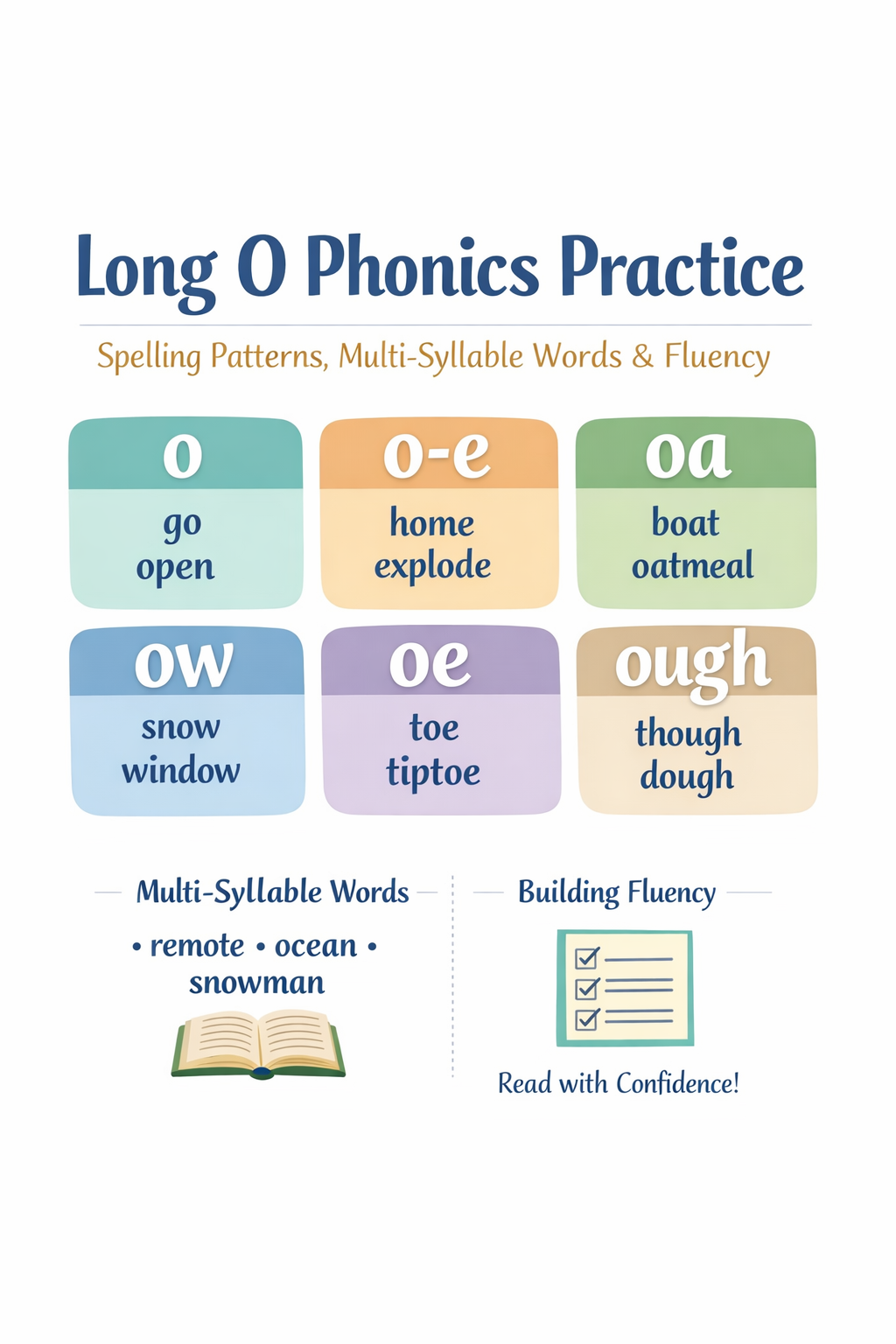
Common long O spelling patterns include:
o (open, moment)
o-e (hope, explode)
oa (boat, oatmeal)
ow (snow, window)
oe (toe, tiptoe)
ough (though, dough)
Students who are comfortable with CVC decoding often struggle when:
• A silent e changes the vowel sound
• A vowel team appears in the middle of a word
• The long O appears in a multi-syllable word
For example:
remote (re-mote)
program (pro-gram)
ocean (o-cean)
moment (mo-ment)
snowman (snow-man)
explode (ex-plode)
These words require both syllable awareness and strong long O pattern recognition.
The Role of Orthographic Mapping in Long O Words
Orthographic mapping is the process that permanently stores words in memory by connecting sounds to spelling patterns.
For example, in hope:
/h/ /ō/ /p/
Students must recognize that the long O sound is represented by o-e.
In though, students must understand that ough represents the long O sound.
When students:
Say the word,
Segment the sounds,
Map each sound to letters,
Write the word while saying sounds,
they strengthen orthographic mapping and long O spelling accuracy.
Without this process, students often spell:
hope as hop
boat as bot
though as tho
Structured long O phonics instruction directly supports spelling development.
What Effective Long O Worksheets Should Include
Strong long O worksheets and long O phonics activities should include:
1. Sorting by Spelling Pattern
Students sort long O words by o, o-e, oa, ow, oe, and ough.
2. Sound-to-Print Mapping
Students stretch sounds and write long O words while saying each sound aloud.
3. Dictation Practice
Students hear a word, segment it, write it, and reread it.
4. Fluency Practice
Students read phrases and passages with high long O density such as:
open the window
the remote control
mix the dough slowly
snow falls over the road
5. Multi-Syllable Long O Words
Students practice decoding:
remote
ocean
program
moment
oatmeal
explode
Multi-syllable decoding is where long O mastery truly solidifies.
How to Practice Long O at Home
If you are using printable long O worksheets or long O phonics activities at home, use a structured routine:
Review long O spelling patterns.
Complete sorting activities.
Practice dictation while saying sounds.
Read a fluency passage.
Reread for smoothness.
Consistent phonics intervention sessions build automaticity and spelling control.
Printable Long O Phonics Practice for Struggling Readers
If you are looking for structured long O worksheets that support decoding, orthographic mapping, spelling, and fluency, the Advanced Code: Long O Phonics Practice Packet provides:
Long O spelling patterns (o, o-e, oa, ow, oe, ough)
Sorting activities
Word cards
Sound-to-spelling mapping
Dictation
Fluency passages
Multi-syllable practice
Progress checks
This printable long O phonics resource supports structured literacy instruction and targeted phonics intervention.
Interested in reading intervention ? Click Here
More phonics resources here.
Final Thoughts
Students who can decode CVC and CVCC words may still struggle with advanced code patterns like long O.
When instruction moves beyond basic decoding and intentionally builds orthographic mapping, spelling accuracy, and multi-syllable fluency, reading becomes more efficient and confident.
Strong phonics instruction builds flexible, accurate readers.
Blossoming Skills Reading Therapy
Automatic Reading Is Not Speed(And Why That Distinction Changes Everything)
If your child reads slowly, speed may not be the real issue. Automatic reading depends on orthographic mapping, accurate decoding, and reduced cognitive strain. In this article, you’ll learn why fluency stalls for struggling readers and how building automaticity — not pushing speed — transforms comprehension and confidence.
Many parents tell me:
“She reads so slowly.”
“He needs to read faster.”
“The school says her words per minute are low.”
Speed feels like the problem.
But here’s the truth:
Automatic reading is not speed.
Speed is a byproduct of something deeper.
If we focus only on speed, we miss the real work the brain must do to become a fluent reader.
What Automatic Reading Actually Means
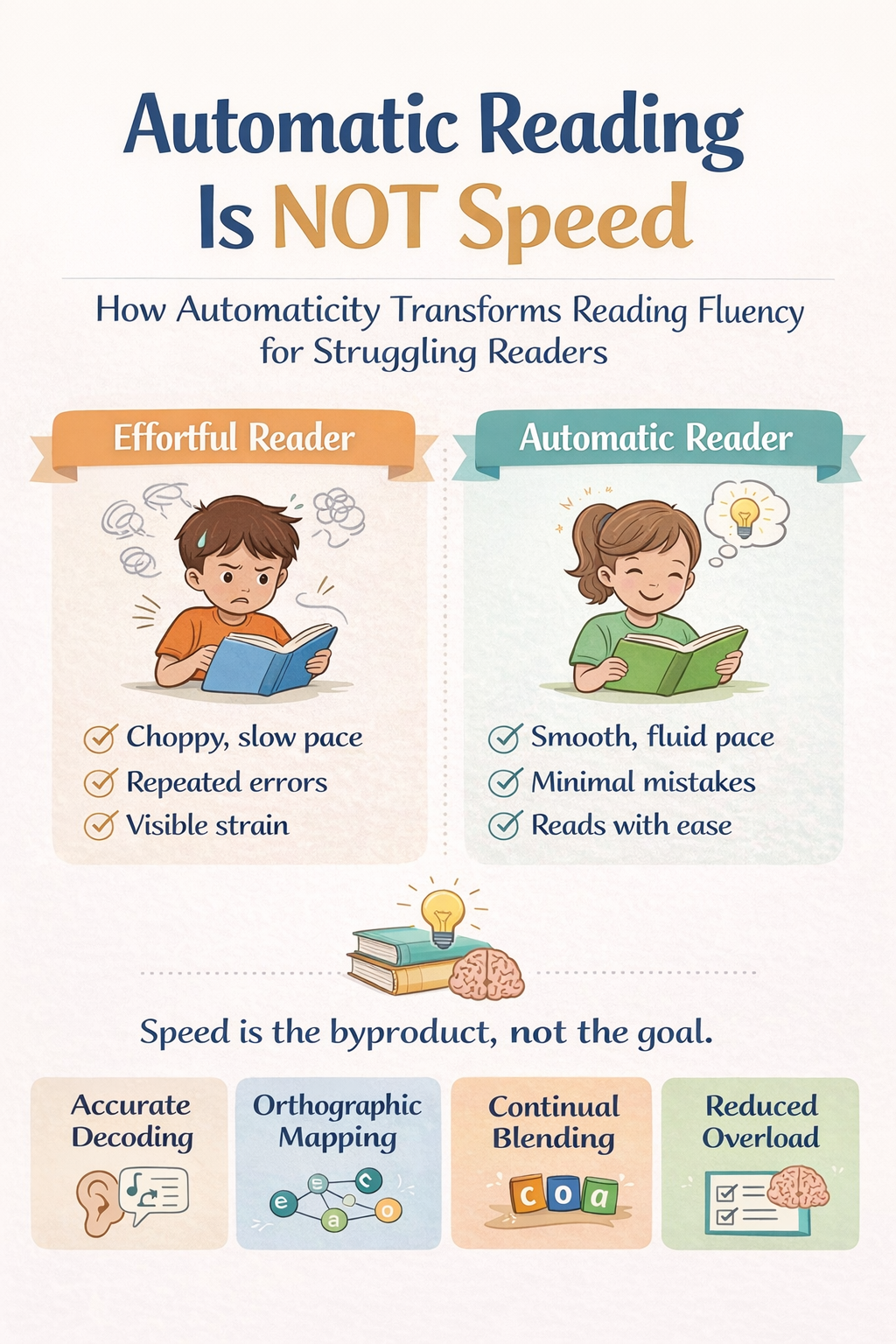
Automatic reading means the brain recognizes words with very little conscious effort.
It includes:
Accurate decoding
Smooth blending
Words stored securely in memory
Minimal mental strain
Stronger comprehension
When reading is automatic, the child is not thinking through every step.
They are not pausing to apply a rule.
They are not guessing.
They are not working through letters one by one with visible effort.
The word simply connects.
And when that happens consistently, speed naturally improves.
Why Speed Alone Is Misleading
Two children can read at the same words-per-minute rate and be having completely different experiences.
One child:
Reads smoothly
Understands what they read
Feels confident
The other:
Strains through every word
Barely remembers the sentence
Feels exhausted afterward
Speed does not tell you how much cognitive energy was required.
And for struggling readers, that energy cost matters.
What’s Really Happening in the Brain
Reading requires the brain to:
Hear and isolate the sounds in a word
Connect those sounds to letters
Blend them smoothly
Store the word in long-term memory
Recognize it automatically next time
If any of those steps are fragile, reading stays effortful.
And when reading is effortful, automaticity doesn’t develop.
Instead, you may see:
Slow, choppy reading
Repeated errors on familiar words
Guessing based on first letters
Avoidance
Fatigue
This is not laziness.
It is load.
The Role of Orthographic Mapping
Automatic reading depends heavily on orthographic mapping.
This is how words become permanently stored in memory.
When orthographic mapping is strong:
The child doesn’t re-decode the same word repeatedly
Words feel familiar instantly
Blending becomes smoother
Reading pace increases naturally
When mapping is incomplete:
Words feel new every time
Reading stays slow
Fluency stalls
Speed drills won’t fix weak mapping.
Foundational skill work will.
Why Fluency Improves When Automaticity Improves
When decoding becomes automatic:
Working memory is freed
Attention can shift to meaning
Comprehension strengthens
Endurance increases
Confidence grows
That’s when reading starts to look fluent.
Not because we forced speed —
but because we reduced strain.
What Actually Builds Automatic Reading
If your child is stuck reading slowly despite knowing phonics, the solution is not “read faster.”
It’s strengthening the system that creates automaticity:
Phonemic awareness
Sound-to-print connections
Continuous blending
Strategic spelling integration
Structured repeated reading
Reduced cognitive overload
When these are in place, automatic reading develops.
And once automatic reading develops, speed follows.
If You’re Watching Your Child Struggle
If reading still feels hard even though your child “knows the rules,” the question isn’t:
“How do we make them faster?”
The better question is:
“Is their reading automatic yet?”
If not, the work is still foundational — not motivational.
And that is fixable.
Next Steps
If you’re unsure whether your child’s reading is automatic or still effortful, you can:
• Download the free Reading Root-Cause Checklist
• Book a free Reading Clarity Call
• Learn more about the 12-Week 1:1 Reading Therapy Program
When reading becomes automatic, everything changes.
Speed.
Confidence.
Comprehension.
Peace at the kitchen table.
Automatic reading is not speed.
It is ease.
And ease can be built.
www.blossomingskillsreadingtherapy.net
Why Reading Suddenly Gets Harder in 3rd Grade(And What It Means If Your Child Is Falling Behind)
Reading often feels harder in 3rd grade because the demands change. Text becomes longer, vocabulary grows more complex, and fluency becomes essential for comprehension. If your child suddenly seems to be falling behind, the issue may not be motivation — it may be foundational decoding and automaticity gaps that are now being exposed.
Many parents say the same thing:
“She was doing fine in 1st and 2nd grade…
and then 3rd grade hit.”
Homework takes longer.
Reading becomes emotional.
Confidence drops.
Teachers start mentioning “fluency” and “comprehension.”
If this sounds familiar, you’re not imagining it.
Reading really does change in 3rd grade.
And for struggling readers, that shift can feel overwhelming.
What Changes in 3rd Grade Reading?
In early elementary school, reading instruction focuses heavily on learning to decode:
Short vowel words
Simple sentences
Predictable texts
Strong teacher support
Children can often compensate with effort, memory, or context clues.
But around 3rd grade, everything shifts.
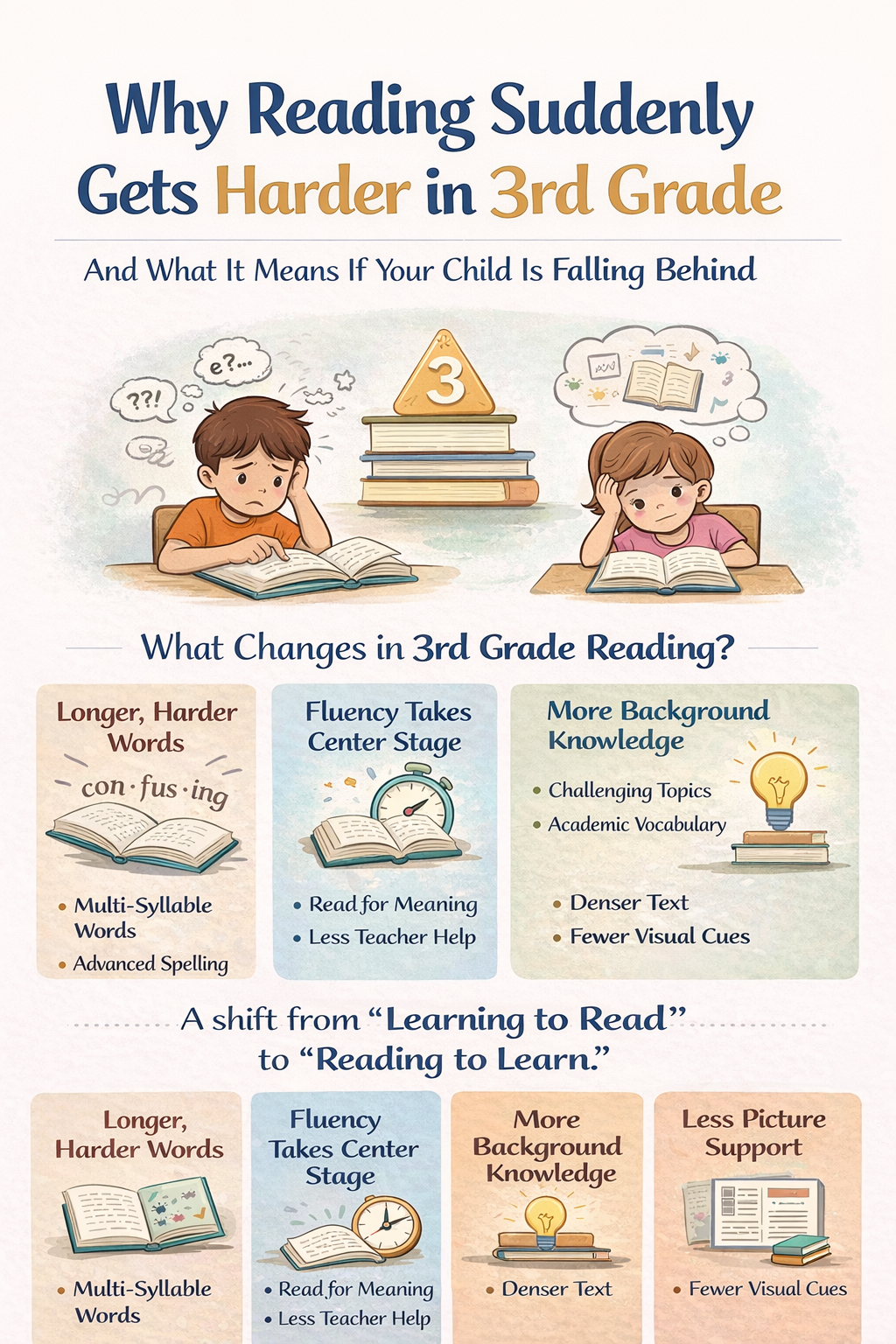
This is sometimes called the move from:
“Learning to Read” → “Reading to Learn.”
And here’s what that shift actually requires.
1. Words Get Longer and More Complex
Texts begin including:
Multi-syllable words
Advanced spelling patterns
Academic vocabulary
Morphological endings
If a child’s sound-to-print mapping is not automatic, decoding these words becomes slow and effortful.
Slow decoding affects:
Fluency
Endurance
Comprehension
The child may technically “know phonics,” but reading no longer feels smooth.
2. Fluency Becomes Essential
In early grades, teachers help heavily with decoding and meaning.
By 3rd grade, students are expected to:
Read independently
Read longer passages
Answer comprehension questions without support
If reading is still effortful, the brain is using too much energy just to decode words.
There’s little left for understanding.
This is where many children begin to:
Read slowly and choppily
Lose their place
Avoid reading
Say they “hate reading”
It’s not about motivation.
It’s cognitive overload.
3. Background Knowledge Matters More
Text in upper elementary becomes more content-driven:
Science
Social studies
Informational text
Historical narratives
Students need:
Strong vocabulary
Prior knowledge
Sustained attention
If decoding is not automatic, they struggle to keep up with the meaning of what they’re reading.
4. Less Picture Support, More Text
In early readers, pictures support meaning.
By 3rd grade:
Pictures fade
Paragraphs lengthen
Text density increases
Guessing from pictures no longer works.
Students who relied on memorization or context clues suddenly struggle.
Why Some Children Hit a Wall
Many children appear “fine” in early grades because they:
Memorized sight words
Used picture cues
Relied on short texts
Managed with effort
But when:
Text gets longer
Words get harder
Independent comprehension is required
Weak foundational skills become visible.
Common hidden gaps include:
Weak phonemic awareness
Incomplete orthographic mapping
Limited automatic word recognition
Working memory overload
Underdeveloped fluency
When the foundation isn’t fully built, the weight of upper-grade reading exposes it.
What This Does to Confidence
Around 3rd or 4th grade, children begin to notice:
Peers reading faster
Increased academic demands
Teacher expectations rising
They may:
Avoid reading
Act distracted
Say it’s “boring”
Become frustrated or tearful
Parents often feel confused:
“She used to love books. What happened?”
What happened is this:
Reading stopped feeling manageable.
What Actually Helps
When reading gets harder, the solution is not:
“Read more.”
Instead, progress comes from:
Strengthening phonemic awareness
Rebuilding sound-to-print connections
Targeting orthographic mapping
Practicing structured, repeated reading
Reducing cognitive overload
Increasing intensity when needed
When decoding becomes automatic, fluency improves.
When fluency improves, comprehension follows.
When comprehension follows, confidence returns.
If Your Child Is Falling Behind
If reading suddenly feels harder in 3rd or 4th grade, don’t panic.
This is often a sign that:
The foundation needs strengthening — not that your child can’t learn.
With the right support, many children experience rapid growth once instruction aligns with how the brain actually processes language.
Next Steps
If you’re unsure why your child is struggling, start here:
✔ Download the free Reading Root-Cause Checklist
✔ Book a free Reading Clarity Call
✔ Explore the 12-Week 1:1 Reading Therapy Program
The shift in 3rd grade doesn’t have to define your child’s story.
With the right approach, reading can become manageable — and even enjoyable — again.