
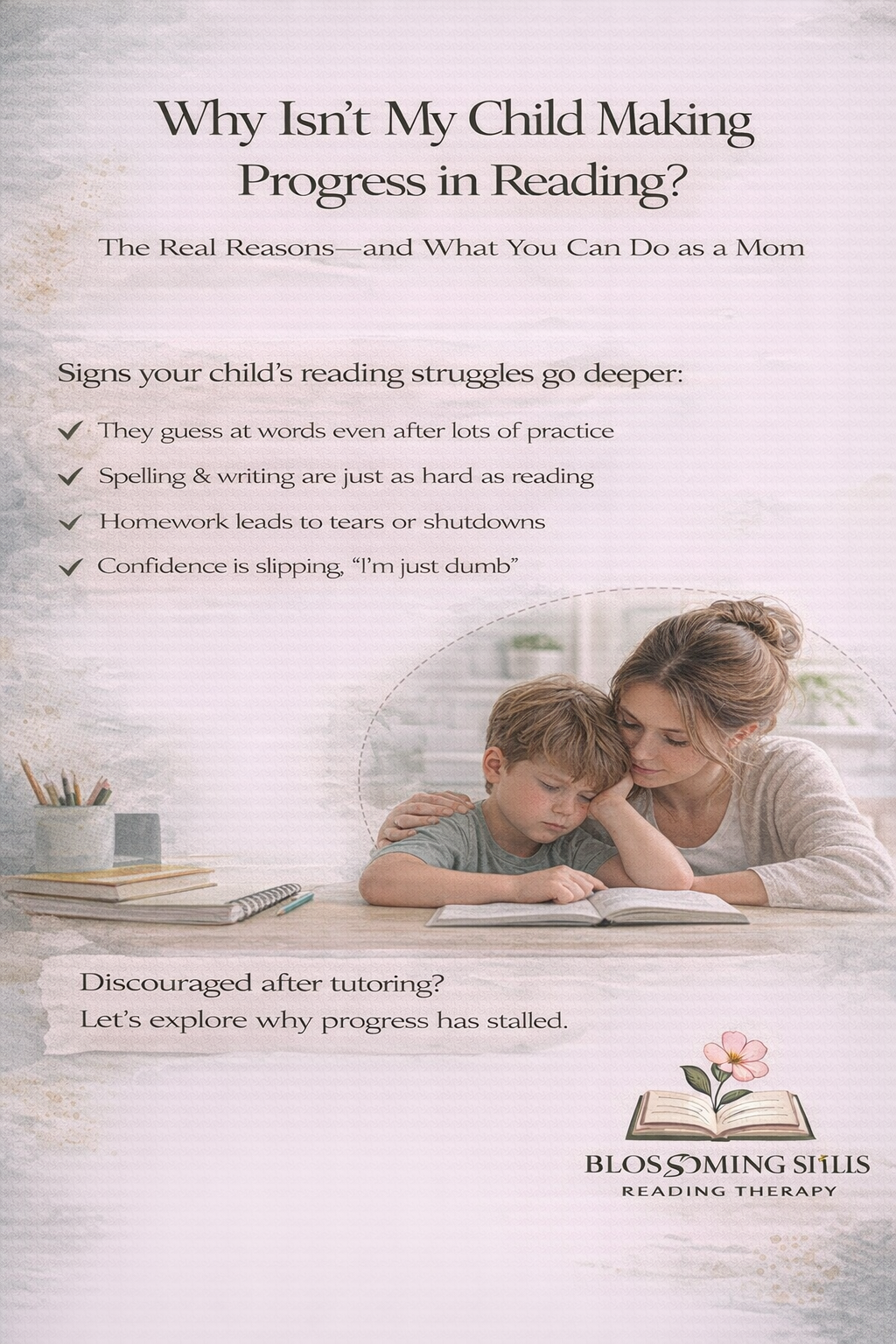
Why Isn’t My Child Making Progress in Reading?
Why isn’t my child making progress in reading—even after tutoring, phonics practice, and extra help at home? If your child is still guessing at words, struggling with spelling, or losing confidence, the issue may not be effort. Many struggling readers and children with dyslexia need sound-to-print instruction that builds real brain connections, not memorization or rule overload. In this article, you’ll discover the hidden reasons reading progress stalls—and what moms can do to help their child build fluent, confident reading skills.
The Real Reasons—and What You Can Do as a Mom
If you’re a mom whose child is still struggling to read, even after months (or years) of tutoring, you’re not alone.
Every week, I talk to parents who have tried everything—flashcards, apps, after-school help—only to watch their child’s confidence sink lower and lower.
So, what’s really going on?
The Hidden Struggles Behind Reading Failure
Dyslexia and reading difficulties aren’t caused by a lack of effort, intelligence, or love at home.
Most struggling readers have a brain that processes language differently—and surface-level tips or more “drill and kill” just don’t work.
Top signs your child’s reading struggles go deeper:
They guess at words or sound them out incorrectly, even after lots of practice
Spelling and writing are just as hard as reading
Homework is a daily battle, with tears or shutdowns
Their confidence is slipping, and they may say things like, “I’m just dumb”
Why Popular Approaches Often Miss the Mark
Many programs (even expensive, well-known ones) focus on memorization or visual tricks—asking kids to memorize sight words, rules, or word shapes.
But research shows that for children with dyslexia, the most effective path is building strong connections between spoken language and print—a method known as “speech-to-print.”
Speech-to-print instruction teaches reading the way the brain naturally learns language:
Start with what your child already knows—spoken words and sounds
Systematically connect those sounds to written letters and patterns
Practice reading and spelling in a way that feels logical, not overwhelming
Real Progress—Not Just More Practice
At Blossoming Skills Reading Therapy, we use a speech-to-print approach that’s backed by brain science and tailored for each child.
Here’s what makes our process different:
Short, focused sessions that respect your child’s mental bandwidth
No overloading of working memory—we avoid overwhelming rules or rote memorization
Personalized support and encouragement for families, not just kids
A real guarantee: Your child will make at least 1 grade level of reading progress in just 12 weeks—or your money back
What Other Moms Are Saying
“My son was significantly behind in reading until we found Catherine. We had tried tutoring before with no progress. I decided to try again and I’m so glad I did!”
—Parent of a Blossoming Skills Student
“She’s not a tutor, she’s a skilled reading therapist with the skills, knowledge, heart, and understanding to teach any child who learns differently, like my son.”
—Homeschool Parent
What Can You Do Next?
If you’re tired of seeing your child work so hard for so little progress, it’s time for a new approach—one that honors both the science and your family’s emotional journey.
Download my free Honest Parent Guide to Dyslexia Programs to see clear, research-backed comparisons of the most popular interventions, real parent stories, and the details of our unique guarantee.
[Download Your Free Guide]
or
Visit: www.blossomingskillsreadingtherapy.net
You don’t have to keep guessing. Real reading progress—and real hope—are possible.
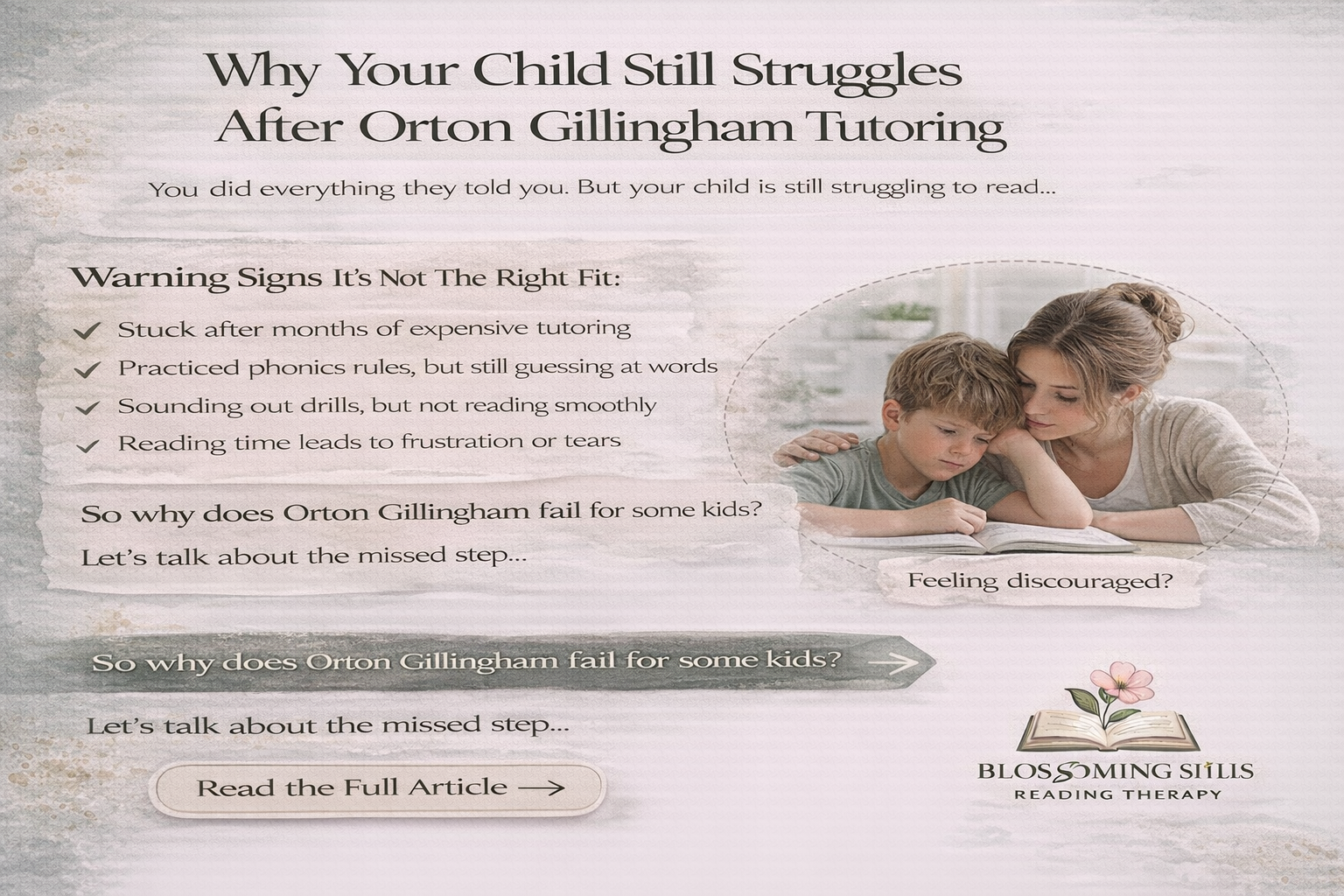
Why Your Child Still Struggles After Orton Gillingham Tutoring
Why is your child still struggling after Orton-Gillingham tutoring? If your child has dyslexia or ongoing reading difficulties despite months or years of structured phonics instruction, you’re not alone. Many struggling readers learn rules but never develop automatic word recognition or fluent decoding in real text. In this article, we explore why Orton-Gillingham doesn’t work for every child — and how speech-to-print, brain-aligned reading instruction can rebuild confidence and lasting reading progress.
If you’re here because your child has dyslexia or is struggling to read, you’re in the right place. I share practical, research-based strategies that rebuild the reading pathway — without overwhelming rules or guesswork.
For step-by-step dyslexia reading help at home, including monthly toolkits and live coaching, start with the Reading Clarity Membership.
You did everything they told you.
You found the program. You paid for the tutor. You followed every suggestion.
But here you are.
Months, maybe even years, later.
And your child still struggles to read.
If that sounds familiar, please know something important:
You’re not alone. And it’s not your fault.
The Method Isn’t Always the Miracle
Orton-Gillingham. It’s a name that comes up again and again. It’s been around for decades. People talk about it like it’s the gold standard.
But what happens when it doesn’t work?
Because for a lot of kids... it doesn’t.
Not completely. Not consistently. Sometimes, not at all.
You may have heard:
“Just give it more time.”
“Every child moves at their own pace.”
“It’s evidence-based.”
But time keeps passing. And your child is still stuck on the basics.
So now what?
Why Doesn’t It Work for Every Kid?
Let’s talk about the method for a second.
Orton-Gillingham focuses heavily on phonics, breaking down words, rules, patterns.
And sure, that works for some learners.
But not all.
Some kids don’t learn best by memorizing dozens of rules with dozens of exceptions.
They don’t need more drills. They need clarity. Something that makes actual sense.
There’s a moment where parents start to notice...
“My child can say the sounds out loud, but they still can’t read the word.”
Or...
“They practiced this all week, but today it’s like they’ve never seen it before.”
It’s not that your child isn’t trying. It’s not that they’re lazy. It’s not that you’re not doing enough at home.
It’s that the approach doesn’t match how their brain learns.
There’s Another Way
Instead of starting with letters and trying to force sounds onto them...
What if we started with spoken language?
That’s what speech-to-print methods do.
Kids already know how to talk. They understand sounds. They use them all day, every day.
So when reading instruction connects to what they already know, the confusion fades.
We stop giving them 10 different spelling rules they can’t remember.
We stop asking them to memorize sight words that don’t follow the rules.
We just teach them how the code works, in a way that’s actually usable.
Why So Many Kids Hit a Wall with Phonics Rules
Some kids can memorize 20 spelling rules and use them just fine. But others? They sit there staring at a word like “enough” or “could,” and nothing about it makes sense. That’s because phonics-heavy systems are often built around patterns and too often, English doesn’t follow those patterns. These kids try to remember the rules, then the exceptions, then the exceptions to the exceptions. And somewhere along the way, they just shut down. It's not because they’re lazy. It's because their brain doesn’t store and recall language that way. That’s why you may see your child read a word correctly one day and totally blank on it the next. They’re not forgetting. They never actually understood it in a way that stuck.
Speech-to-print helps remove that confusion by making the connection between spoken sounds and written letters much more direct. It’s not “memorize and hope”, it’s understand and apply. And that changes everything.
If You’re Feeling Tired, That Makes Sense
Parents don’t get told this stuff. Not in schools. Not in most tutoring centers.
You’re led to believe that Orton-Gillingham is the answer.
And if it’s not working, the problem must be with your child.
But the problem is the method doesn’t work for everyone.
And honestly? That’s okay.
No single program is perfect.
But you deserve to know there’s another option, one that’s simpler, quicker, and yes, often more effective.
The Warning Signs That It’s Not a Fit
If you’re not sure yet, pay attention to these things:
● Is your child making real progress, or just going through the motions?
● Do they dread reading time, even with help?
● Can they sound out words in isolation, but not in a book?
● Are they still guessing at words they’ve seen a hundred times?
If these sound familiar... trust your gut. You don’t need more time in the same system.
You might just need a better fit.
The Hidden Cost of Waiting
One of the hardest things to admit as a parent is that something’s not working. We don’t want to pull our child out of a program everyone else seems to trust. We don’t want to be the difficult one. So we wait. A few more months. Another semester. Maybe next year it will click. But all the while, your child is falling further behind and worse, they’re internalizing the struggle. They start thinking something is wrong with them. That they’re “not smart” or “just bad at reading.” That pain shows up later in school avoidance, low confidence, or even behavior changes.
And here’s the thing: the longer we wait, the harder it is to rebuild that self-trust. Yes, finding a better method takes effort. But staying in the wrong one comes at a cost too, one we don’t always see until it’s already deep. Acting now isn’t just about reading. It’s about preserving how your child sees themselves.
There’s Hope, Really
The most heartbreaking part is seeing how many parents blame themselves.
You wonder:
“Did I wait too long?”
“Should I be doing more at home?”
“Maybe my child just isn’t a reader.”
Please hear this:
You didn’t fail. And your child isn’t broken.
They just haven’t been taught in a way that clicks with their brain yet.
That can change.
Let’s Try Something That Actually Works
You’ve waited long enough.
If the rules and routines haven’t worked, if the flashcards feel endless, if your child is still stuck, you don’t have to keep going in circles.
There’s a better way.
We teach kids in a way that respects how they think, how they speak, how they understand.
And when that happens... things shift.
They stop resisting.
They start reading.
And maybe for the first time, they believe they can do it.
You don’t need years of tutoring. You need the right method.
Let’s talk. Fill out the contact form or send a message. We’re here when you’re ready.
👉 catherine@blossomingskillsreadingtherapy.net